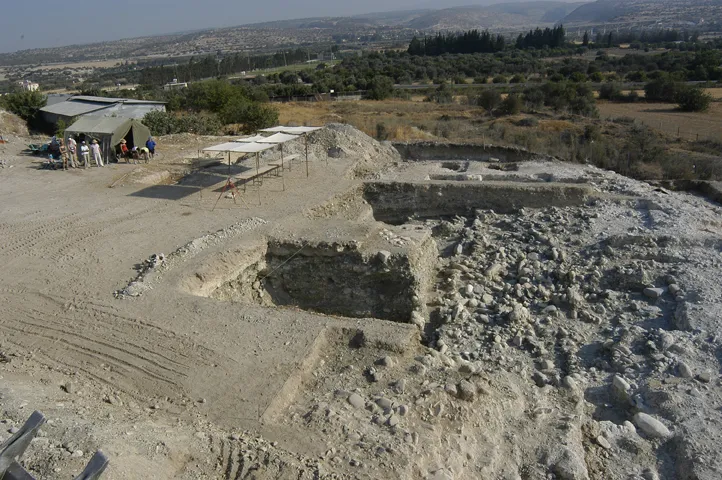
Overview of the excavation site in what was the ancient city of Bamboula, a Bronze Age city that was an important trading center for the Middle East, Egypt and Greece.
The cultural and economic center of the ancient Mycenaean city of Bamboula, near what is now Cyprus, was well-protected by an ancient wall, and may have served as a fortress to protect the city from outside threats.
Bamboula was flourishing in the late Bronze Age, between the 13th and 11th centuries B.C. The remains of the once-great city currently sit outside the modern village of Episkopi along the southwestern coast of Cyprus. It served as an ancient trading center, and grew wealthy off the copper from the nearby Troodos Mountains.
The remains of a staircase and lintel blocks at the late Bronze Age fortress that stood on the site.
(Image credit: Colleen Kelley)
The team, led by Gisela Walberg of the University of Cincinnati, started uncovering the site in 2001. Their most recent find is a set of walls that appear to belong to a Late Bronze Age (1500-750 B.C.) fortress that may have functioned to protect the urban economic center. The walls are about 15 feet (4.8 meters) thick, much more robust than any building walls would be.
"It's quite clear that it is a fortress because of the widths and strengths of the walls. No house wall from that period would have that strength. That would have been totally unnecessary," Walberg, a professor of classics, said in a statement. "It is on a separate plateau, which has a wonderful location you can look north to the mountains or over the river, and you can see the Mediterranean to the south — so you can see whoever is approaching."
The team also found the remains of a set of stairs, which would have led to an observation tower. The towers seem to have been destroyed during a violent incident at the site, possibly a major social upheaval.
The researchers will present their findings on June 25 at the annual workshop of the Cyprus American Archaeological Research Center, in Nicosia, Cyprus.
You can follow LiveScience staff writer Jennifer Welsh on Twitter @microbelover. Follow LiveScience for the latest in science news and discoveries on Twitter @livescience and on Facebook.
Sign up for the Live Science daily newsletter now
Get the world’s most fascinating discoveries delivered straight to your inbox.
Jennifer Welsh is a Connecticut-based science writer and editor and a regular contributor to Live Science. She also has several years of bench work in cancer research and anti-viral drug discovery under her belt. She has previously written for Science News, VerywellHealth, The Scientist, Discover Magazine, WIRED Science, and Business Insider.