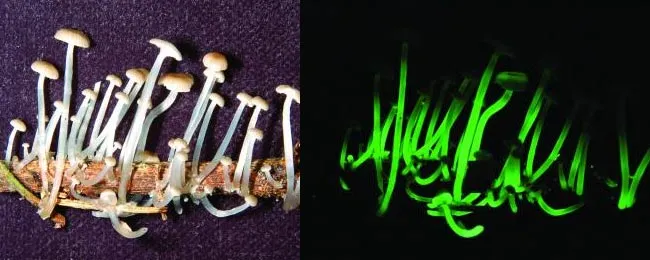
As if teensy night-lights were dangling from tree trunks and branches, glow-in-the-dark mushrooms illuminate the forests across the globe. Now, scientists have discovered several species of such radiant 'shrooms.
The freaky findings, reported today in the journal Mycologia, increases the number of aglow mushroom species from 64 to 71, shedding light on the evolution of luminescence in nature.
The newly identified mushrooms, which emit a bright, yellowish-green light 24 hours a day, were found in Belize, Brazil, Dominican Republic, Jamaica, Japan, Malaysia and Puerto Rico. They include four species new to science and three new reports of luminescence in known species.
Latest Videos From
"If daylight was not so bright you could see them during the day, but the greenish-yellow light does not stand out against daylight so we cannot visualize them," lead researcher Dennis Desjardin of San Francisco State University told LiveScience. "But take them into a dark room at any time of day, and wait until your eyes adjust to the darkness, and you'll see them glow very nicely."
Here are some of the highlights:
- Found on sticks in an Atlantic forest habitat, Mycena luxaeterna is tiny, each cap spanning 0.3 inches (8mm) in diameter, with jelly-like stems. (The species' name, which means "eternal light," was inspired by Mozart's "Requiem.")
- One psychedelic-looking mushroom, called Mycena silvaelucens, was found on the bark of a standing tree at the Orangutan Rehabilitation Center in Borneo, Malaysia. Each mushroom cap measuries just over a half inch (18 mm) in diameter.
- So-called Mycena luxarboricola was collected from the bark of a living tree in an old growth Atlantic forest in Paraná, Brazil. Each cap measures less than 0.2 inches (5 mm) in diameter. (The species' name, which means "light dwelling on a tree," was also inspired by Mozart's "Requiem.")
Three quarters of glowing mushrooms, including the newly identified species, belong to the Mycena genus, a group of mushrooms that feed off and decompose organic matter.
"What interests us is that within Mycena, the luminescent species come from 16 different lineages, which suggests that luminescence evolved at a single point and some species later lost the ability to glow," Desjardin said.
He and other scientists still have many questions about such glow-in-the-dark fungi, including how and why they light up. They know the luminescent process is similar to that of glowing bacteria and other luminescent organisms. For instance, the glowing involves a luciferin-luciferase mediated reaction that emits light in the presence of water and oxygen. But they are not sure of the exact chemical compounds involved in the reaction.
As for why, Desjardin says some fungi glow to lure in nocturnal animals that aid in the dispersal of the mushroom's spores, which are similar to seeds and are capable of growing into new organisms. Fungi, along with plants, animals and protists are considered eukaryotes by biologists, meaning "true kernel," due to the packaging of the genome into the membrane-bounded compartment called the nucleus. (Simple bacteria and archaea, which lack a cell nucleus, are considered prokaryotes.)
To date, Desjardin has discovered more than 200 new fungi species, including a phallic mushroom.
This research was supported by the National Science Foundation and the National Geographic Society.

 Live Science Plus