
 Live Science Plus



Exotic Particles May Hold Clues to Mysterious Dark Matter

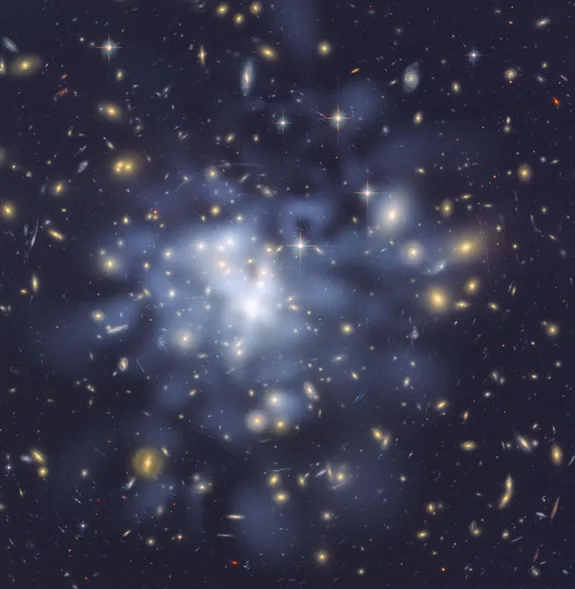
Dark matter makes up about 80 percent of the universe's mass, but scientists still don't know what the strange stuff is.
Scientists have proposed a number of particles as candidate components of mysterious dark matter, which is so named because it apparently neither emits nor absorbs light. The hunt is on to find and characterize these exotic particles, from WIMPS to sterile neutrinos to axions.
"The theory space for what dark matter might be is immense," Shunsaku Horiuchi, of the University of California-Irvine, said at a news conference at the April meeting of the American Physical Society in Savannah, Georgia. [Explaining Dark Matter (Infographic)]

A strong case for WIMPs

When the Big Bang created the universe 13.8 billion years ago, dark matter particles were produced along with the "normal" matter that we can see and touch. Collisions between dark matter particles may have annihilated many of the particles, but as the universe cooled and expanded, the rate of collision slowed, leaving behind the dark matter that exists today, scientists say.
First proposed in the 1980s, Weakly Interacting Massive Particles (WIMPs) are perhaps the leading candidate for dark matter. WIMPs are about 100 times more massive than electrons and interact through gravity and the weak nuclear force. WIMPs don't interact strongly with normal matter, but they do interact with one another, producing detectable gamma rays in the process.
One of the many detectors looking for WIMPs is run by the Coherent Germanium Neutrino Technology (CoGeNT) collaboration. CoGeNT's detector sits deep underground inside the Soudan mine in Minnesota, sheltered from background interference. A crystal of the element germanium sits inside a box, waiting for a rare collision between an incoming WIMP particle and the nucleus of a single atom in the detector. The collision causes a recoil that generates a small amount of measurable energy.
Get the world’s most fascinating discoveries delivered straight to your inbox.
Blas Cabrera of Stanford University presented an update of the CoGeNT collaboration's search for dark matter. By changing out silicon detectors for germanium, he reports a higher confidence in the team's results.
Recently, another team examined the CoGeNT data and thought they located WIMPs. However, the CoGeNT team repeated the analysis and found WIMPs in multiple detectors — a sign, Cabrera said, that the detection was not the potential dark matter particles.
"WIMPs should interact so weakly that they never interact in two detectors," Cabrera said.
Instead, he believes the signals were background noise, which led the team to improve their modeling of the data.
As yet, no potential WIMP detections have been confirmed — but that serves to narrow down the possible interactions.
"As the central regions for the WIMP model are being explored and WIMPs are not found, that means it is important for us to broaden the search between all possible interactions between dark matter and nuclei," Cabrera said.

Prolific sterile neutrinos
Another potential source of dark matter are sterile neutrinos, hypothetical particles that only react to gravitational forces. The particles are tiny, less than a billionth the mass of a proton.
"Sterile neutrinos are motivated to explain neutrino masses, how active neutrino masses are so small," Horiuchi said.
Produced at the universe's birth, sterile neutrinos would not interact with non-neutrino particles. Instead, they would slowly decay while emitting X-rays.
Scientists expect dark matter to dominate dwarf galaxies such as those that surround the Milky Way. [Stunning Photos of Our Milky Way Galaxy (Gallery)]
"The best measurements are coming from X-rays and small galaxies," Horiuchi said.
He reported that, in February, two independent papers announced the detection of X-ray lines in various dark matter densities not explained by astrophysical events. Both papers, which were published online and have not yet been subjected to peer review, constructed a model created by sterile neutrino decay, which fit the observed detections far better than any astronomical sources.
Axions are everywhere
A third possible source for dark matter are axions, hypothetical particles predicted as a result of nuclear physics. Their low mass and theoretical high abundance led scientists to propose them as potential dark matter, though they could well exist and not be a part of the mysterious mass of the universe.
Axions have lifetimes longer than the age of the universe and should exist all around us. Gray Rybka of the University of Washington says that 100 quadrillion (1017) axions would fit in a cup of coffee.
Rybka works on the Axion Dark Matter Experiment (ADMX), searching for axions with a large, superconducting magnet. When axions collide with the magnetic field and bounce off, they should create detectable photons a trillionth the size of the electron. Tuning rods can change the frequency of the magnet, allowing the experiment to search for axions at a variety of frequencies.
"The experiment operates a lot like an AM radio, tuning the frequency trying to find your station," Rybka said.
Operating at cryogenic temperatures, ADMX avoids searching for axions in regions that other dark matter experiments have already excluded, instead focusing on the remaining potential masses over the next six years.
"We're going to search the entire plausible region for axion dark matter," Rybka said. "By the time the experiment is finished, if axion dark matter is out there, we will have found it."
All for one?
Dark matter could consist of WIMPS, sterile neutrinos, axions or other particles not yet considered. It could also exist as a combination of several particles, researchers said.
"We could be in a universe with 50 percent WIMPs, 50 percent sterile neutrinos," Horiuchi said. "They're not in conflict with one another."
Rybka also noted that his team had anticipated "the possibility that axions make up some fraction but not all of dark matter," tuning their search accordingly.
Most scientists want to see the tantalizing mystery of dark matter solved, no matter what the particle is or who finds it.
"I want to know who the dark matter is, and I don't care who discovers it," Cabrera said.
His sentiment was echoed by other scientists, but Rybka said he was willing to be different.
"I would prefer to find dark matter first," he said with a smile.
Follow us @Spacedotcom, Facebook or Google+. Originally published on Space.com.

Nola Taylor Tillman is a contributing writer for Live Science and Space.com. She loves all things space and astronomy-related, and enjoys the opportunity to learn more. She has a Bachelor’s degree in English and Astrophysics from Agnes Scott college and served as an intern at Sky & Telescope magazine. In her free time, she homeschools her four children.