

















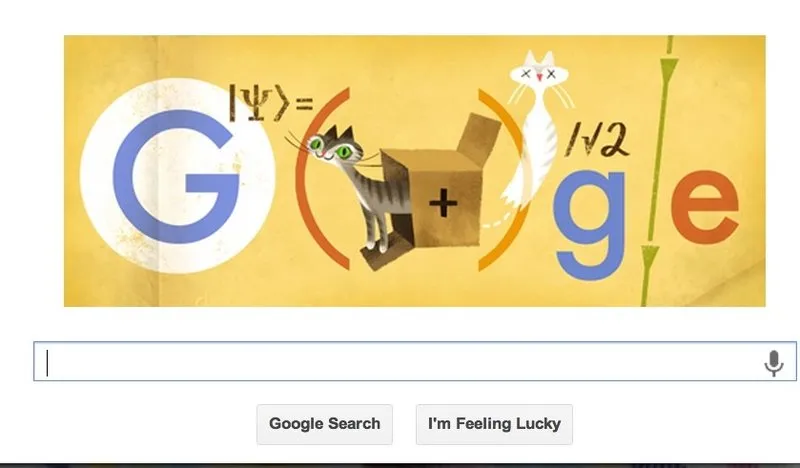
Google honored the physicist Erwin Schrödinger with a custom-made doodle today, on what would have been his 126th birthday. The doodle depicts Schrödinger's cat, a famous thought experiment that probes the implications of the fact that quantum particles can exist in multiple states until they are measured.
The famous physicist was born in Austria in 1877 and began working on some of the fundamental questions of quantum mechanics by the 1920s. Schrödinger devised several fundamental equations that describe how the behavior of tiny particles changes over time. He died in 1961 after a long bout of tuberculosis.
But he may be most famous for his Schrödinger's cat thought experiment. That experiment posited the existence of an imaginary cat trapped inside of a box with a vial of poisoned gas, which opens when a radioactive particle randomly decays. Quantum mechanics says that we cannot know if the particle has decayed, the vial has opened and the cat has met his demise until we measure the decay. In theory then, the cat is both alive and not-alive until the box is measured, and the vial is either opened or not.
Follow Tia Ghose on Twitter @tiaghose. Follow LiveScience @livescience, Facebook & Google+.
Get the world’s most fascinating discoveries delivered straight to your inbox.

Tia is the editor-in-chief (premium) and was formerly managing editor and senior writer for Live Science. Her work has appeared in Scientific American, Wired.com, Science News and other outlets. She holds a master's degree in bioengineering from the University of Washington, a graduate certificate in science writing from UC Santa Cruz and a bachelor's degree in mechanical engineering from the University of Texas at Austin. Tia was part of a team at the Milwaukee Journal Sentinel that published the Empty Cradles series on preterm births, which won multiple awards, including the 2012 Casey Medal for Meritorious Journalism.