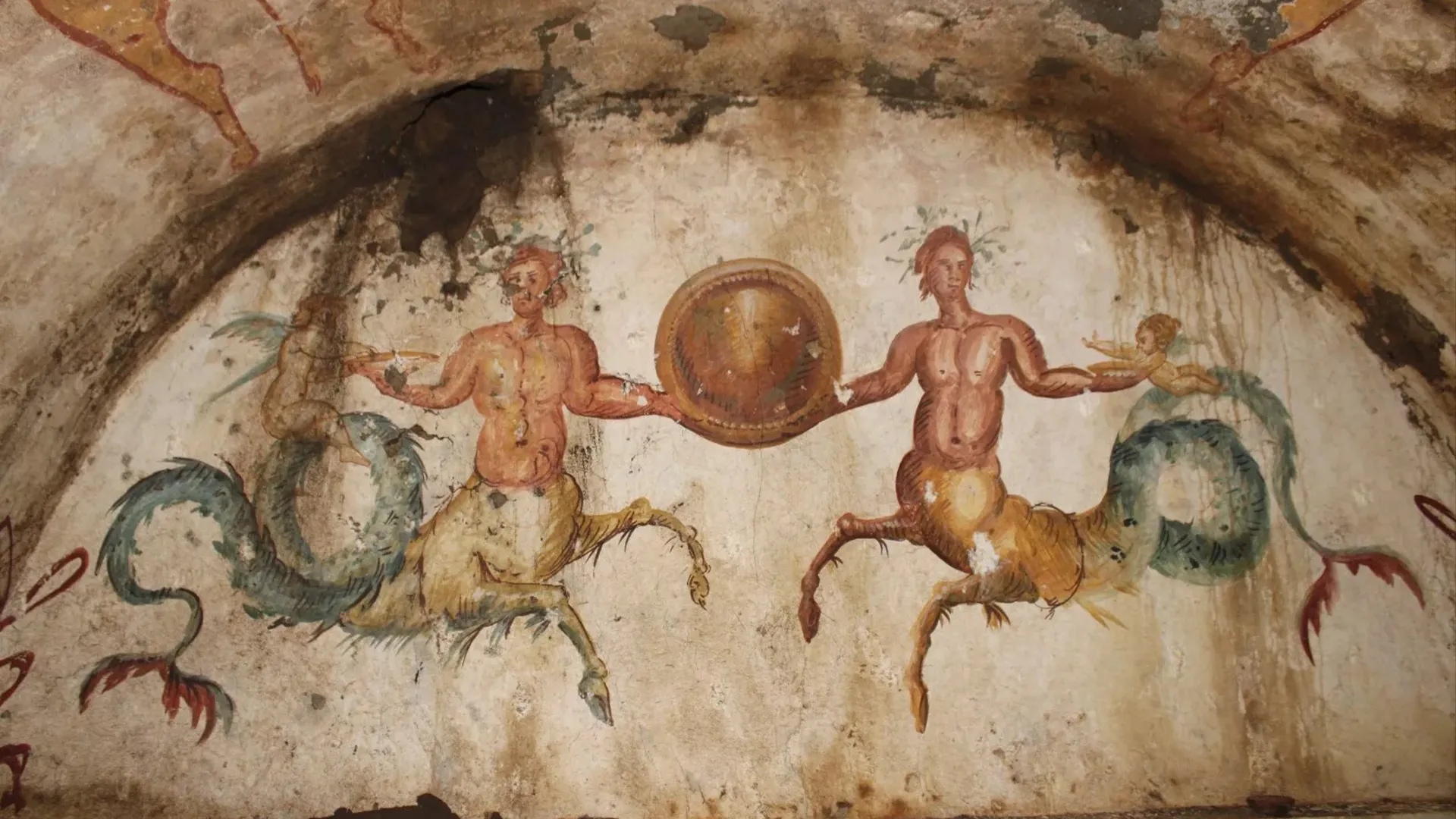
Archaeologists in Italy were ecstatic last year after discovering a 2,200-year-old tomb decorated with stunning murals, including paintings of the three-headed hellhound, Cerberus, and of ichthyocentaurs — sea centaurs with the head and torso of a human, the front legs of a horse, and the tail of a fish.
Now, archaeologists have analyzed more of the burial, known as the Tomb of Cerberus, in Giugliano, which is near an ancient necropolis from Roman times. These excavations have revealed the skeleton of an individual who was covered in a shroud and surrounded by various grave goods, including jars of ointment and a strigil, a Roman personal hygiene tool used to scrape off dirt, perspiration and oil before a person bathed.
The deceased, who was in an "excellent state of preservation," according to a translated statement from the Italian Ministry of Culture, had been buried on their back. It appears that the "particular climatic conditions of the funerary chamber" had mineralized the shroud, according to the statement.
Researchers are collaborating across fields — including archaeology, chemistry, paleobotany and anthropology — to learn more about the individual, who was possibly the "progenitor of the family for which the mausoleum was built," according to the statement. The interdisciplinary team plans to study the shroud to see if they can determine where its yarn was manufactured.
Meanwhile, ancient pollen samples from the tomb suggest the deceased was treated with creams containing absinthe, as well as Chenopodium, a genus of herbaceous, flowering plants also called goosefoot, according to the statement.
A view inside the tomb showing the shroud and some other grave goods.
(Image credit: Superintendency for the Metropolitan Area of Naples; Italian Ministry of Culture)
The archaeologists are still awaiting DNA results from the deceased, which could reveal their ancestry and whether they had any genetic conditions.
Sign up for the Live Science daily newsletter now
Get the world’s most fascinating discoveries delivered straight to your inbox.
"The Tomb of Cerberus continues to provide precious information on the Phlegraean territory," Mariano Nuzzo, superintendent of the Italian Ministry of Culture, said in the statement. The territory is a large volcanic field located near the ancient city of Liternum. Information gleaned from the tomb is "expanding knowledge of the past, and offering opportunities for research of a multidisciplinary nature," Nuzzo said.
Laura is the managing editor at Live Science. She also runs the archaeology section and the Life's Little Mysteries series. Her work has appeared in The New York Times, Scholastic, Popular Science and Spectrum, a site on autism research. She has won multiple awards from the Society of Professional Journalists and the Washington Newspaper Publishers Association for her reporting at a weekly newspaper near Seattle. Laura holds a bachelor's degree in English literature and psychology from Washington University in St. Louis and a master's degree in science writing from NYU.