













Ancient Roman 'spike defenses' made famous by Julius Caesar found in Germany
Archaeologists have found ancient Roman "barbed wire," famously used and written about by Julius Caesar, for the first time near a German silver mine.

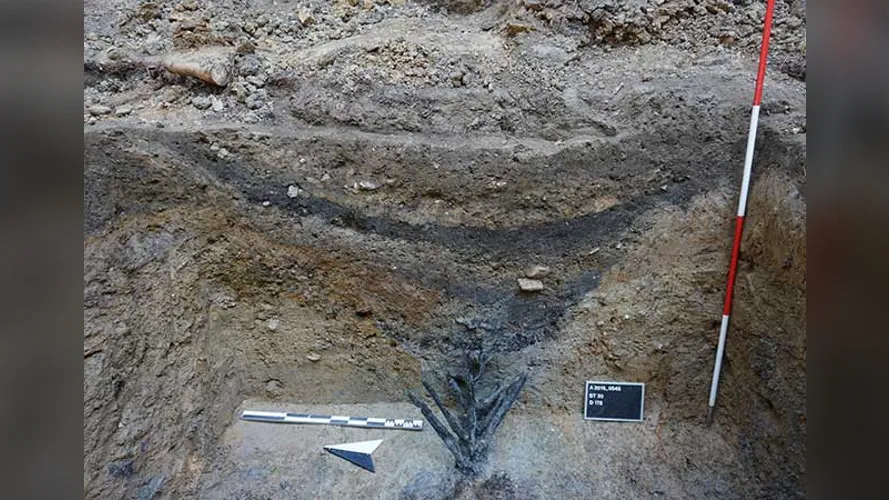
In 52 B.C., Julius Caesar used an ingenious system of ditches and stakes to defend his soldiers from an encroaching Gallic army in modern-day central France. More than two millennia later, archaeologists have discovered the first preserved example of similar defensive stakes, which likely protected an ancient silver mine.
A student team made the unprecedented discovery in the area of Bad Ems, halfway between the present-day cities of Bonn and Mainz in Germany, on the former northern border of the Roman Empire.
Archaeologists have been working in the area of Bad Ems since the late 19th century. Early excavations yielded processed silver ore along with wall foundations and metal slag, so researchers believed that they comprised smelting works dating to the early second century A.D. But in 2016, a hunter noticed odd crop formations and told archaeologists at Goethe University, who later found that the area hosted a 20-acre (8 hectares) double-ditched Roman camp with the remains of around 40 wooden watchtowers.
Related: Vast subterranean aqueduct in Naples once 'served elite Roman villas'
This year, the student team led by Frederic Auth unearthed the preserved wooden spikes in the damp soil of Blöskopf Hill, which held a second recently discovered Roman camp 1.3 miles (2 kilometers) away from the first fort. The team also found a coin from A.D. 43, proving that the two forts significantly pre-dated a larger system of fortifications known as the "limes" that was constructed in A.D. 110. The limes (meaning "boundary line") was the fortified border wall that ran along the northern Roman Empire.
Related stories
The ancient Roman historian Tacitus offered clues to what the two forts were defending: He noted that a Roman governor named Curtius Rufus tried to mine silver in this area in A.D. 47, but found little. In reality, Bad Ems had plenty of silver — around 200 tons of it were found centuries later — but the Romans did not dig deep enough to get to it. It is possible that the Romans set up camp to defend themselves from raids as they tried to mine this important raw material, the archaeologists said.
While Julius Caesar (lived from 100 B.C. to 44 B.C.) died long before the forts at Bad Ems were set up, his strategy of creating a ditch-and-spike defensive system outlived him. In his book "Gallic Wars," Caesar wrote about the fortifications he set up in the Battle of Alesia in France in 52 B.C. He wanted his camp to be defended by as few soldiers as possible, so he cut down very thick branches, sharpened them to a point, and sank them into trenches, fastening them firmly at the bottom and covering the ditch with willow branches and twigs. "Whoever entered within them were likely to impale themselves on very sharp stakes," Caesar wrote.
Get the world’s most fascinating discoveries delivered straight to your inbox.
In spite of the well-preserved finds at Bad Ems, mysteries remain surrounding the forts' use. The larger fort was never fully completed, and both forts appear to have been purposefully burned down a few years after their construction. Further research is needed to determine whether the researchers' hypothesis about the forts defending silver mines is correct, Markus Scholz, a professor of Roman archaeology at Goethe University, said in a statement.

Kristina Killgrove is a staff writer at Live Science with a focus on archaeology and paleoanthropology news. Her articles have also appeared in venues such as Forbes, Smithsonian, and Mental Floss. Kristina holds a Ph.D. in biological anthropology and an M.A. in classical archaeology from the University of North Carolina, as well as a B.A. in Latin from the University of Virginia, and she was formerly a university professor and researcher. She has received awards from the Society for American Archaeology and the American Anthropological Association for her science writing.