













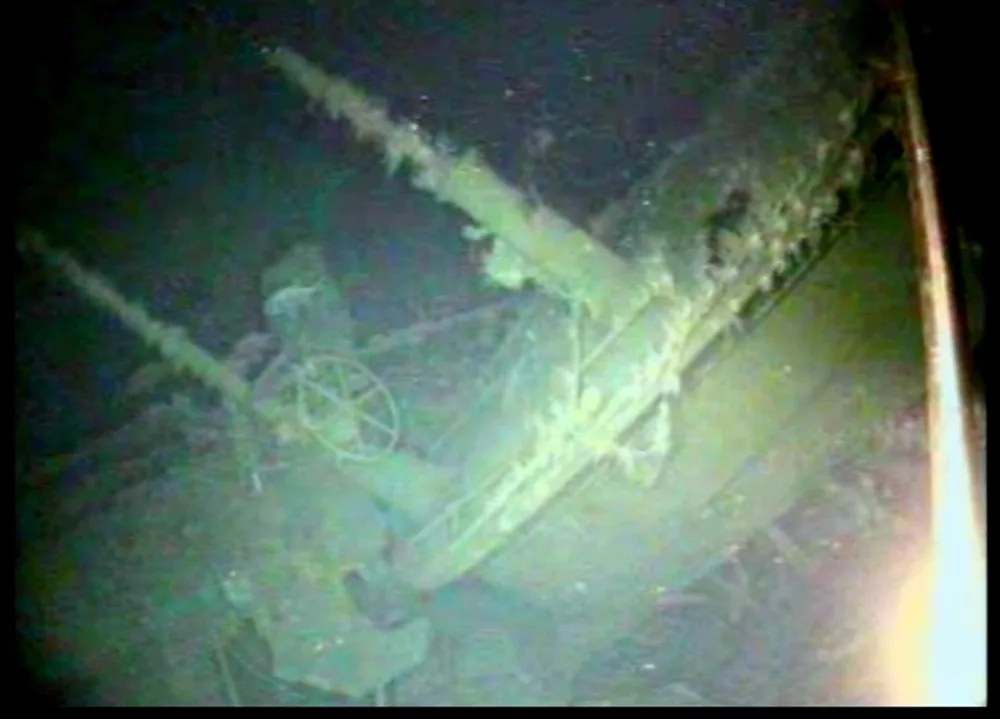
A downed navy submarine that vanished 103 years ago was recently discovered in the remote ocean area around Papua New Guinea.
The Australian Navy submarine HMAS AE1 was discovered near the Duke of York Islands off Papua New Guinea roughly 1,000 feet (300 meters) beneath the ocean's surface, according to a statement.
The HMAS AE1 went missing off Rabaul, Papua New Guinea on Sept. 14, 1914, and all 35 Australian and New Zealander crewmembers aboard were lost. The loss was the first one incurred by the Australian Navy during World War I. [TK See Images of Sunken Submarine Off Papua New Guinea]
An expedition to find the lost vessel was recently initiated and funded by the Australian Government, the Silentworld Foundation, the Australian National Maritime Museum and Find AE1 Ltd. The team used aerial drones and a multi-beam echo sounder to scan the seafloor. The ship was first discovered this month by a search vessel named "Furgro Equator," and a small service to commemorate those who lost their lives was conducted on the ship.
Dozens of ships were lost in the waters of Oceania inWorld War II's Pacific Theater, but only a handful, such as Germany's SMS Planet, were sunk during World War I.
Originally published on Live Science.
Get the world’s most fascinating discoveries delivered straight to your inbox.

Tia is the editor-in-chief (premium) and was formerly managing editor and senior writer for Live Science. Her work has appeared in Scientific American, Wired.com, Science News and other outlets. She holds a master's degree in bioengineering from the University of Washington, a graduate certificate in science writing from UC Santa Cruz and a bachelor's degree in mechanical engineering from the University of Texas at Austin. Tia was part of a team at the Milwaukee Journal Sentinel that published the Empty Cradles series on preterm births, which won multiple awards, including the 2012 Casey Medal for Meritorious Journalism.