













Never-Seen-Before Tetraquark Particle Possibly Spotted in Atom Smasher

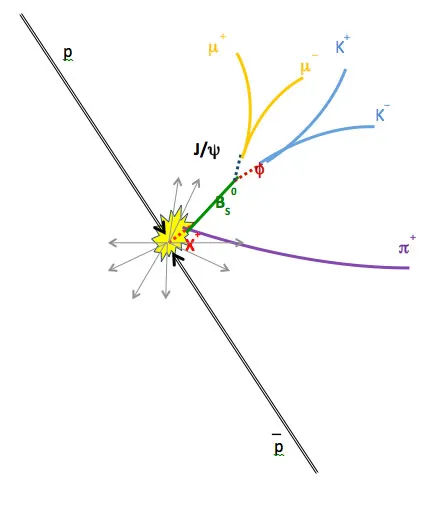
Evidence for a never-before-seen particle containing four types of quark has shown up in data from the Tevatron collider at the Fermi National Accelerator Laboratory (Fermilab) in Illinois. The new particle, a class of "tetraquark," is made of a bottom quark, a strange quark, an up quark and a down quark. The discovery could help elucidate the complex rules that govern quarks — the tiny fundamental particles that make up the protons and neutrons inside all the atoms in the universe.
Protons and neutrons each contain three quarks, which is by far the most stable grouping. Pairs of quarks, called mesons, also commonly appear, but larger conglomerations of quarks are extremely rare. Scientists at the Large Hadron Collider (LHC) in Switzerland last year saw the first signs of a pentaquark—a grouping of five quarks—which had long been predicted but never seen. The first tetraquark was found in 2003 at the Belle experiment in Japan, and since then physicists have encountered a half dozen different arrangements. But the new one, if confirmed, would be special. “What’s unique in this case is that we basically have four quarks, which are all different—bottom, up, strange and down,” says Dmitri Denisov, co-spokesperson for the DZero experiment. “In all previous configurations usually two quarks are the same. Is this telling us something? I hope yes.”
The unusual arrangement, dubbed X(5568) in a paper submitted toPhysical Review Letters, could reflect some deeper rule about how the different types, or “flavors,” of quarks bind together—a process enabled by the strongest force in nature, called, appropriately, the strong force. Physicists have a theory—called quantum chromodynamics—that describes how the strong force works, but it is incredibly unwieldy and difficult to make predictions with. “While we understand many features of the strong force, we don’t understand everything, especially how the strong force acts on large distances,” Denisov says. “And on a fundamental level we still don’t have a very good model of how quarks interact when there are quite a few of them joined together.”
One open question is: How many quarks can stick together to form a particle? So far scientists have not seen groupings of more than five, but theoretically there is no limit. Physicists would also like to discover different configurations of four and five quarks than the handful that have been seen. “Finding tetraquarks has proven difficult to do, but it is likely that there are many more to find,” says Fermilab physicist Don Lincoln, a member of the DZero team.
The Tevatron collider shut down in 2011, but the DZero team found signs of the new tetraquark in the archive of data from the tens of billions of particle collisions it achieved during its 28 years of operation. Other experiments such the LHC’s LHCb (“b” stands for beauty) project are now looking through their own data to see if they also have evidence of the particle. “If it is real, it would be very interesting,” says LHCb physicist Sheldon Stone of Syracuse University. “Discussions among LHCb collaborators have raised several issues of concern with the DZero result that LHCb can check expeditiously. Until the check is done and the DZero result is confirmed, we are not sure exactly what they are seeing.”
Either way, scientists expect current particle accelerators—especially the LHC, which restarted last year at higher energy levels than ever before—to discover more new particle configurations in the coming years, making it an exciting time for quark physics and for clearing up the intricate mechanics of the strong force. “I would compare it with something like a puzzle—it’s not finished yet but we've added one more piece to what was already known,” Denisov says. “Hopefully there will eventually be a theory that explains these observations to gain a better understanding of these quarks and the forces acting between them."
This article was first published at ScientificAmerican.com. © ScientificAmerican.com. All rights reserved.
Get the world’s most fascinating discoveries delivered straight to your inbox.
Follow Scientific American on Twitter @SciAm and @SciamBlogs. Visit ScientificAmerican.com for the latest in science, health and technology news.
