
















Whale Explodes During Autopsy (Video)

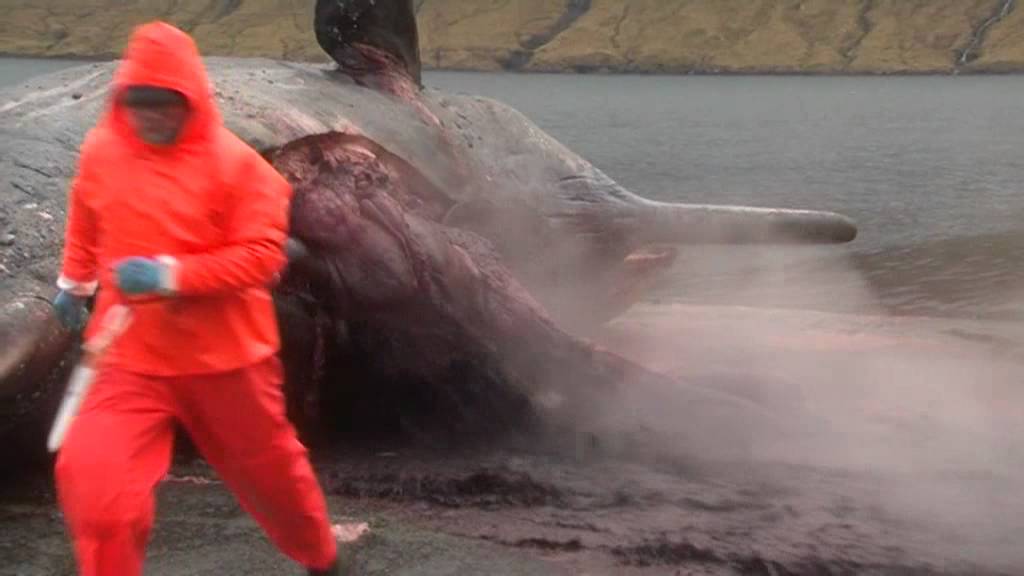
A dead sperm well exploded in a shower of guts and effluvia as a man attempted a seaside autopsy this week.
The whale explosion occured on the Faroe Islands between Iceland and the United Kingdom. A 45-foot (14 meter) sperm whale, dead of natural causes, had washed up on the beach when locals decided to cut the creature open to use its skeleton in a museum display, according to Metro.co.uk. A video (above) posted by The Guardian newspaper shows the messy results.
Whale explosions are disgusting but far from unheard-of. As bacteria inside the whale gut eat away at the dead animal's flesh, they produce gases that can build up inside the corpse. A puncture, such as the one created by the poor Faroe Island marine biologist, can release these gases in a rather abrupt eruption. In 2004, researchers in Tainan, Taiwan, experienced the grossness firsthand while trying to transport a whale carcass from a beach to a laboratory. The resulting whale explosion took 13 hours to clean up.
An even more impressive — and less natural — whale explosion occurred in Florence, Ore., in 1970. The Oregon Highway Division decided to use half a ton of dynamite to blow up a beached, decomposing whale carcass. The idea was that the smaller pieces of whale would be quickly devoured by birds. Unfortunately, the force of the dynamite sent massive chunks of whale blubber flying, flattening cars and forcing crowds to flee.
Follow Stephanie Pappas on Twitter and Google+. Follow us @livescience, Facebook & Google+.
Get the world’s most fascinating discoveries delivered straight to your inbox.

Stephanie Pappas is a contributing writer for Live Science, covering topics ranging from geoscience to archaeology to the human brain and behavior. She was previously a senior writer for Live Science but is now a freelancer based in Denver, Colorado, and regularly contributes to Scientific American and The Monitor, the monthly magazine of the American Psychological Association. Stephanie received a bachelor's degree in psychology from the University of South Carolina and a graduate certificate in science communication from the University of California, Santa Cruz.