















Cloaking: Science Fiction or Science Fact?
This Research in Action article was provided to LiveScience in partnership with the National Science Foundation.
Researchers have successfully cloaked an object in free space with the help of supercomputers at the Texas Advanced Computing Center, with funding from the National Science Foundation and the Department of Defense. Andrea Alù of The University of Texas at Austin and his research group have been working on new ways of cloaking objects in their lab.
Objects are visible when electromagnetic waves bounce — or scatter — off of them and return to an observer. Humans observe scattered visible light. Radar devices observe scattered microwaves.
Cloaking works by placing something around the object that cancels the incoming wave. If nothing scatters off an object, then that object can't be observed from any position.
Alù and his group have successfully cloaked a 7 inch (18 centimeter) long cylinder to sensors that observe microwaves. To conduct the same experiment with visible light, the object would have to be about 100,000 times smaller. That difference in scale is why the researchers use microwaves, with their longer wavelengths.
The cloak fits around the cylinder and is made of metamaterials — manufactured using nanoscale technology and designed to exhibit exotic properties. The cloak's scattering signature — the way it scatters waves — is designed to be the opposite of the cylinder's. This creates a scattering cancellation phenomenon.
"It's kind of a compensation between what the object would do, and what the metamaterial would do," Alù said. "When you combine the two, you cancel the scattering."
Get the world’s most fascinating discoveries delivered straight to your inbox.
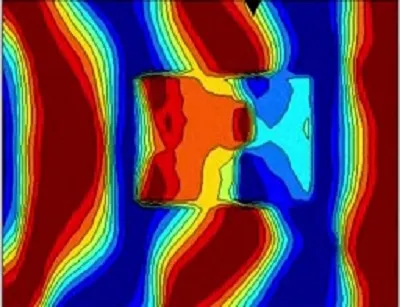
Measurements taken of the cloaked cylinder look like the ones taken of "free space" — there is nothing present to scatter waves. If our eyes saw microwaves instead of visible light, the cloaked cylinder would be invisible.
Alù and his team use the powerful resources at the Texas Advanced Computing Center to plan and refine the design of the metamaterial used for the cloak. TACC's robust, high-performance computing systems facilitate faster discoveries and more accurate results than a regular desktop computer.
There are limitations to this method of cloaking, but one day soon we could have the ability to cloak larger and more diverse objects. Practical applications include cloaking the tips of sensing devices used in nanoscale research so that the tips do not interfere with observations of objects or the cloaking of "hot spots" on stealth planes, making them even less detectable.
Editor's Note: Any opinions, findings, and conclusions or recommendations expressed in this material are those of the author and do not necessarily reflect the views of the National Science Foundation. See the Research in Action archive.