













Pee Power: Researcher Says Urine Deserves Separate Treatment

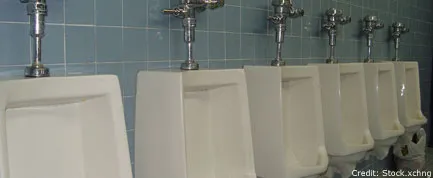
Separating urine from the rest of sewage would save electricity at treatment facilities, says Jac Wilsenach, who is getting his Ph. D. by studying the idea.
Among the challenges: Toilets would all have to be replaced by new versions that do the separating, likely requiring men to sit down when they go Number 1.
Here's why it might be worth it:
While urine accounts for less than 1 percent of wastewater, it contains 50 to 80 percent of the nutrients that need to be filtered out, said Wilsenach, of Delft University of Technology in The Netherlands.
By separating urine, phosphate and nitrogen that need to be removed can be extracted more effectively. Wilsenach concludes that if 50 percent of the urine is separately purified, the energy needed to do the treating would be cut by 25 percent.
An added bonus, Wilsenach says: Sewage wouldn't stink so much.
Oh, and about those new toilets. Here's how that setup would work: Urine would be collected in tanks that serve a building or a neighborhood, then periodically transported to a purification plant.
Get the world’s most fascinating discoveries delivered straight to your inbox.
Another idea might be to use the pee to run a battery, a process perfected in separate research reported last year. Or, maybe the folks over at the U.S. Centers for Disease Control and Prevention would be interested. They buy pee, as do drug companies, and it seems there's never enough to go around.
Wilsenach's study, announced today, has not been reported in a peer-reviewed journal.

Robert is an independent health and science journalist and writer based in Phoenix, Arizona. He is a former editor-in-chief of Live Science with over 20 years of experience as a reporter and editor. He has worked on websites such as Space.com and Tom's Guide, and is a contributor on Medium, covering how we age and how to optimize the mind and body through time. He has a journalism degree from Humboldt State University in California.