













Image Gallery: Digging Up at Tomb at the Swedish Stonehenge

Megalithic monument
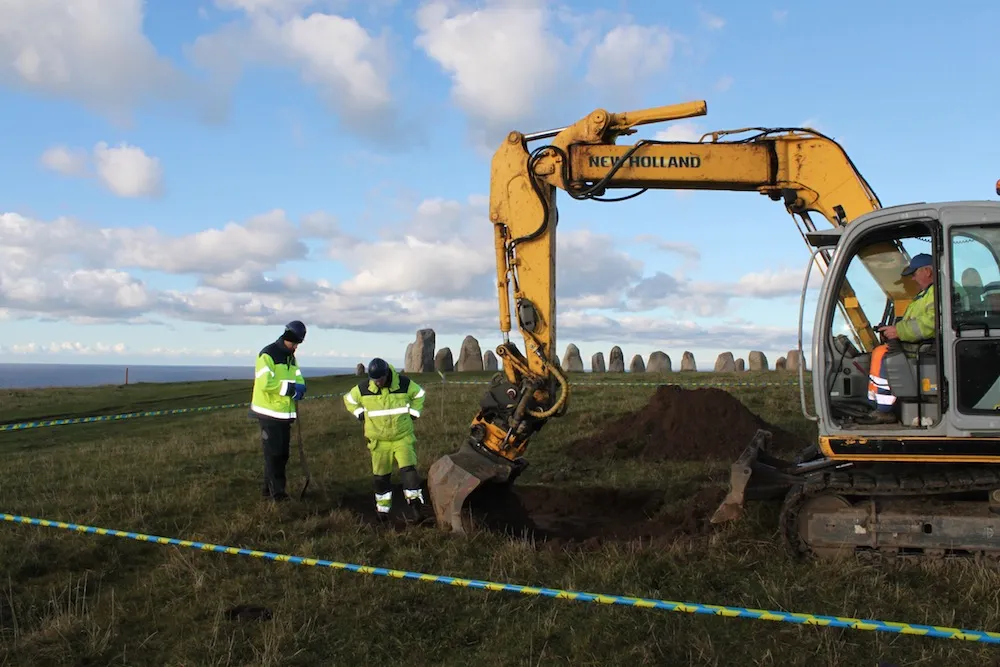
A 5,500-year-old tomb possibly belonging to a Stone Age chieftain has been unearthed at a megalithic monument in the shape of a ship called the Ale's Stenar (Ale's Stones). The tomb was likely robbed of stones to build the nearby Viking-era ship monument. Here, archaeologists Björn Wallebom and Bengt Söderberg are just starting the excavation on Oct. 12, 2012, with the Ale's stones in the background.
Help from technology

In 2006, archaeologists used magnetic sensors and radar to map the area's underground terrain and found a larger circular structure about 541 feet (165 m) across. And only recently, in October 2012, did scientists actually begin to dig there. Here, archaeologists dig trench in the foreground, Ale's stones in the background.
Evidence of history

The team unearthed the imprints of giant boulders that had been removed long ago. Though they didn't find a skeleton, the imprints suggested the site was a Neolithic burial chamber called a dolmen — several upright stones with a horizontal boulder on top. Here, archaeologist Björn Wallebom clears the northern brim of the dolmen on Oct. 14, 2012.
Time to work

Archaeologists Bengt Söderberg and Magnus Andersson clearing the northern brims of the dolmen on Oct. 14.
Giant Ship

Ale's Stones are perched on a seaside cliff in the village of Kåseberga and consist of 59 massive boulders arranged in the 220-foot (67-meter)-long outline of a ship.
Astronomical Calendar?
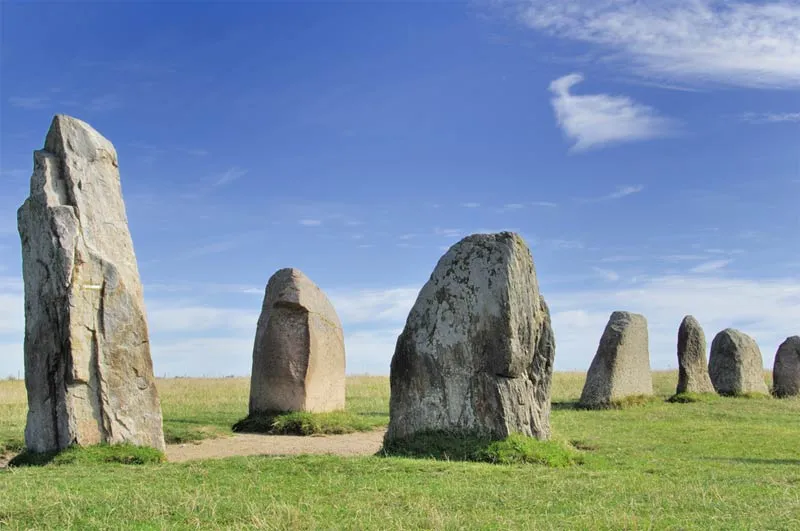
Archaeologists generally agree Ale's Stones was built some 1,000 years ago as a burial monument. But a team of researchers, in the March 2012 issue of the International Journal of Astronomy and Astrophysics, argues the megalithic structure is really 2,500 years old, dating from the Scandinavian Bronze Age; they suggest it was built as an astronomical calendar with the same underlying geometry as England's Stonehenge.
Building a Megalith

Scientists think members of a warlike community of seafarers built Ale's Stones using oxen, slaves, rope, sleds, wooden spades and simple steel tools to collect and raise the huge boulders.
Get the world’s most fascinating discoveries delivered straight to your inbox.
