 Live Science Plus





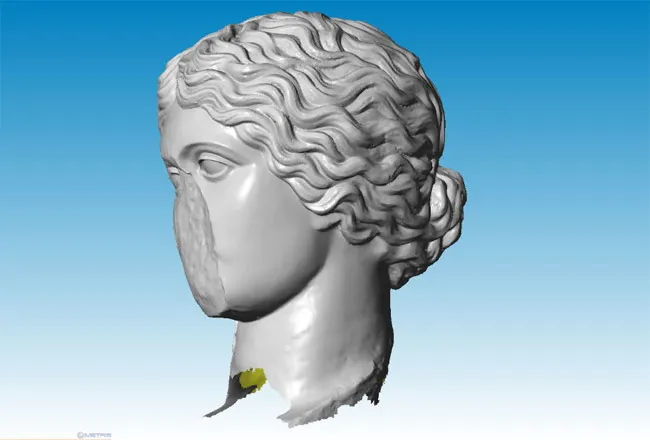
Laser-scanning and computer graphics are breathing virtual life into a 2,000 year-old statue of an Amazon warrior.
The Roman statue was discovered by the Herculaneum Conservation Project in the ancient ruins of Herculaneum, a town preserved in the same eruption that buried nearby Pompeii in AD 79.
"The statue is an incredible find," said study researcher Mark Williams of the University of Warwick's WMG (formerly Warwick Manufacturing Group). "Although its age alone makes it valuable, it is unique because it has retained the original painted surface, preserved under the volcanic material that buried Herculaneum."
Williams measured every surface of the bust and translated that information into a computer model. Meanwhile, WMG's Greg Gibbons used rapid prototyping to create a physical 3-D model of the head. And Graeme Earl, an archaeologist at the University of Southampton in England, and his colleagues used a novel form of photography to create a detailed record of the texture and color of the painted surfaces.
"Cutting-edge techniques are vital to the recording of cultural heritage material, since so much remains unstudied or too fragile to analyze," Earl said.
The Southampton team is now digitally re-modeling and re-painting the sculpture. They are using techniques derived from the film industry to recreate the original carved and painted surfaces.
In the final step Alan Chalmers, head of WMG's visualization team, will use the computer model to reproduce the lighting and environmental conditions under which the painted statue would have originally been created and displayed. This visualization will provide archaeologists with an otherwise impossible view of how the original statue may have looked in context, and allow them to experiment with different ideas.
"Our work will be used both for educational and research purposes to give people new insights into the statue's design, to provide a record for conservators, and to explore how it may have been appreciated over 2,000 years ago," Chalmers said.
- Video – Lost Civilization of the Amazon Rainforest
- History's Most Overlooked Mysteries
- Quiz: The Artifact Wars

