













The Dead Outnumber the Living (Infographic)

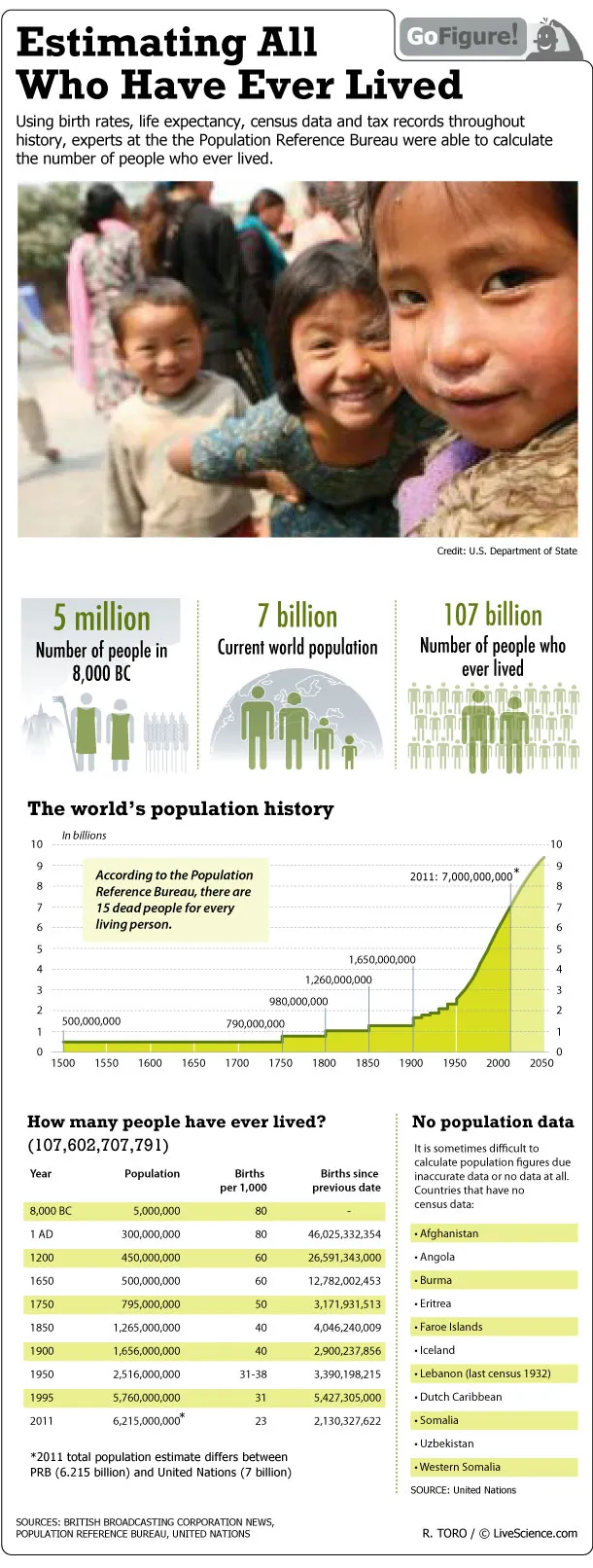
How many people have ever lived on Earth? That question, it seems, has a long shelf-life, according to scientists at the Population Reference Bureau (PRB) in Washington, D.C., who say they often get information calls with that query.
The curious question apparently stems back to the 1970s when a writer made the statement that 75 percent of the people who had ever been born were alive at that moment. "For this 'estimate' to be true would mean either that births in the 20th century far, far outnumbered those in the past or that there were an extraordinary number of extremely old people living in the 1970s," PRB writes on its website.
PRB demographers have come up with what they say is a "semi-scientific" method for calculating a better estimate of all who have lived on this orb. That's because "absolutely no demographic data available for 99 percent of the span of the human stay on Earth," they write. To come up with their estimate, they had to determine the length of time humans have existed on Earth and the average size of the human population at different times. Though there's no straightforward answer to when the human race first stepped foot on Earth, the researchers used a number from the United Nations Determinants and Consequences of Population Trends, which estimates modern Homo sapiens may have appeared about 50,000 B.C.
Next, the researchers came up with birthrates for each time period, based on various factors, including life expectancy and the birthrate needed for the species to survive. They also assumed a constant growth rate for each time period, though in reality the population may have fluctuated greatly due to famines, climate change and other factors, they say.
Their calculation, updated with 2011 numbers suggests about 108 billion births since the dawn of the human race. That number would change if the date of humanity's arrival on Earth were to change or if more was known about the human population fro the period 8000 B.C. to A.D. 1.
Carrying that estimate out reveals that about 6.5 percent of all people ever born are alive today.
- Extending Life: 7 Ways to Live Past 100
- Crowded Planet: 7 (Billion) Population Milestones
- After Death: 8 Burial Alternatives That Are Going Mainstream
Get the world’s most fascinating discoveries delivered straight to your inbox.
