

A gigantic asteroid brought the age of the dinosaurs to an abrupt end about 66 million years ago, as everything from pterodactyls to Tyrannosaurus rex went extinct. Fortunately, the lives of these iconic creatures were preserved in fossils — allowing researchers to decipher this lost world.
At Live Science, our expert writers and editors bring you the latest dinosaur news, features and articles, from extraordinary dinosaur discoveries to answering your burning prehistoric questions like "What color were the dinosaurs?" and "Could evolution ever bring the dinosaurs back?"
Discover more about dinosaurs

-
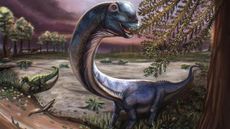 'Last titan' of Thailand discovered, and it's the longest-necked dinosaur on record from Southeast Asia
A newfound species of long-necked dinosaur from Thailand lived up to 120 million years ago, and it's the largest known of its kind from Southeast Asia.
-
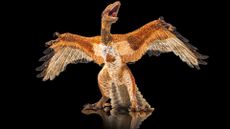 'He began to cry, and almost fell to the floor': The fluffy fossil that finally showed the world that birds are dinosaurs
In this excerpt from "The Story of Birds", author Steve Brusatte explores the moment where paleontologists realized they had critical evidence to show birds came from dinosaurs — a fluffy fossil from China.
7 Comments -
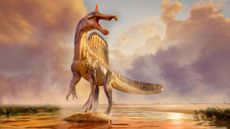 95 million-year-old Spinosaurus had a scimitar-shaped head crest and waded through the Sahara's rivers like a 'hell heron'
Researchers have identified a new Spinosaurus species with a blade-like crest in Niger, changing our understanding of dinosaur evolution and behavior.
2 Comments -
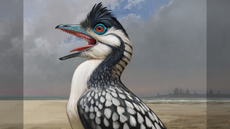 Archaeopteryx, one of the world's first proto birds, has a set of weird, never-before-seen features, new study reveals
Iconic transition species between dinosaurs and birds may have had weird 'teeth' on roof of its mouth and a highly mobile tongue, study reveals
-
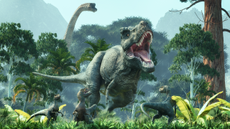 T. rex quiz: How much do you really know about the king of the dinosaurs?
Almost everyone has heard of Tyrannosaurus rex, but how much do you actually know about this iconic dinosaur predator? Take our quiz to find out.
-
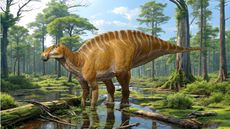 Giant 'cow of the Cretaceous' discovered almost 100 years ago identified as new duck-billed dinosaur
The dino lived during the Late Cretaceous alongside other hadrosaurids in present-day New Mexico.
-
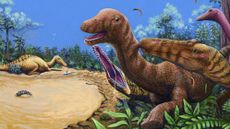 Spinosaurus relative longer than a pickup truck stalked Thailand's rivers 125 million years ago
A large fish-eating dinosaur died beside a river 125 million years ago in Cretaceous Thailand. Now, the remains of this ancient predator are helping researchers better understand Asia's enigmatic spinosaurids.
-
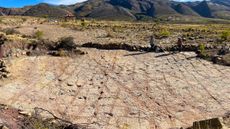 18,000 dinosaur tracks discovered along ancient Bolivian coastline — and they set a new record
Researchers have counted 16,600 fossilized dinosaur footprints and 1,378 swim tracks at a site in Bolivia that showcase a variety of behaviors and different theropods from the Cretaceous period.
7 Comments -
 Nanotyrannus isn't a 'mini T. Rex' after all — it's a new species, 'dueling dinosaurs' fossil reveals
An argument over whether fossils from several small dinosaurs represent a juvenile Tyrannosaurus rex or smaller adults of a separate species may finally be settled.


