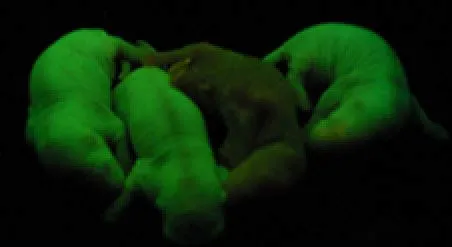
In lab rats, "Who's your daddy?" can now yield a surprising answer. Scientists have generated rats from mice that developed rat sperm.
The breakthrough marks the first time researchers produced healthy offspring [Photo] from sperm cells fostered in a different species. The hope is this method could help generate sperm from endangered species or prize bulls.
A decade ago, scientists successfully developed sperm in one animal that had come from cells in another. Researchers began by growing rat sperm in mice, and proceeded to foster sperm from hamsters, rabbits, pigs, bulls and humans in mice as well.
Latest Videos From
However, until now it remained unknown whether any of these sperm were fertile. In several instances they developed abnormally in their foreign hosts.
The breakthrough
Reproductive biologist Takashi Shinohara at Kyoto University in Japan and his colleagues first began with rats genetically engineered to produce a green fluorescent protein. Their cells and progeny would thus prove easy to recognize. Shinohara and his colleagues then removed the stem cells that sperm arise from in the rats and implanted them into testicles of mice.
The scientists collected fluorescent green rat sperm from the mice and injected them into rat eggs. Successfully fertilized eggs were transferred into surrogate rat mothers.
None of the fluorescent green rat pups born—yes, they are really green—displayed any abnormalities, genetic or otherwise. Moreover, they grew up to become fertile adults.
Breeders use sperm taken from prize livestock to produce offspring that hopefully possess the same valuable traits. Scientists also use sperm to help endangered species generate progeny. The hope is that mice or other lab animals can grow sperm of livestock or endangered species while "saving space, food and in general being easier to take care of," Shinohara told LiveScience.
Human applications
The capability this opens up to study human sperm generated using this method could lead to novel contraceptives, Shinohara added, or in studying what contaminants are toxic to male reproduction.
While this breakthrough raises the possibility of growing human sperm in other animals to generate viable human offspring, "it is not a good idea," Shinohara said. Besides the ethical issues, he noted there are viruses present in animals that could write themselves into genetic codes of the human sperm.
Shinohara and his colleagues reported their findings online Aug. 28 via the Proceedings of the National Academy of Sciences.

 Live Science Plus