
 Live Science Plus


Exploding Rocks Dredged from Seafloor

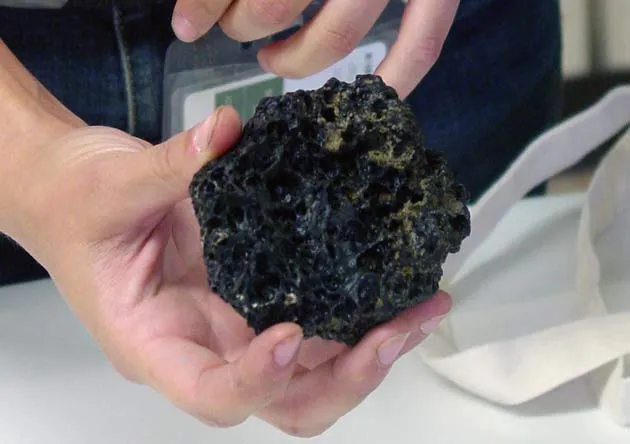
Newfound undersea rocks explode when hauled to the surface and could hold a treasure trove of information about Earth's insides.
The rediscovered "popping rocks" have been known since they were first found in a voyage off the coast of Mexico 45 years ago.
Attempts to find them again have failed until now.

Ten failures ...
A team of geologists set out earlier this month to search the undersea Popcorn Ridge for the source of the exploding rocks first reported by Scripps Institution of Oceanography researcher Dale Krause back in 1960.
They hauled ten loads of rocks up with no luck. Then sonar revealed a small mound at the base of Popcorn Ridge, and the scientists dredged that spot, about 2 miles (3,200 meters) below the surface.
"As soon as we took the rocks out of the water we could hear them popping, much like a firecracker," said Barry Eakins, a post-doctoral researcher at Scripps and one of scientists on the voyage. "We were very excited because we knew this was a big find."
Get the world’s most fascinating discoveries delivered straight to your inbox.
The mound is now named Krause Volcano.
The popping is caused by pressurized volcanic gases trapped in bubbles within the lava rocks. When they're no longer confined by the pressure of the deep water, the bubbles pop.
Clues to inner Earth
The volcanic rock comes from below Earth's crust, in a region called the mantle. So the trapped gases, including carbon dioxide, water vapor, helium and argon, should represent concentrations that exist in the mantle, a part of Earth that scientists are trying to drill into but have yet to reach.
Studying the popping rocks could improve understanding of gases inside the Earth as well as the history of Earth's atmosphere, which scientists believe has always been heavily influenced by volcanic events.
"We expect that these rocks will be the source of research for decades," Eakins said.
The discovery of the Krause Volcano is interesting by itself. It appears to be just centuries old, perhaps even less than 100 years.
"There are lots of volcanoes on the seafloor but most are quite old," said Dana Vukajlovich, a Scripps graduate student. "It's exciting to find one that may be very, very young and possibly still active."
- Earth's Core Rotates Faster than Surface, Study Confirms
- Inside an Earthquake: Geologists Penetrate Fault Zone 2 Miles Down
- Hole Drilled to Bottom of Earth's Crust, Breakthrough to Mantle Looms
- Finally, a Solid Look at Earth's Core
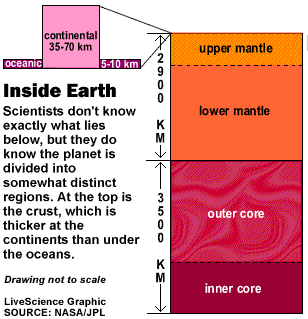
The crust thickness averages about 18 miles (30 kilometers) under the continents, but is only about 3 miles (5 kilometers) under the oceans. It is light and brittle and can break. In fact it's fractured into more than a dozen major plates and several minor ones. It is where most earthquakes originate.
The mantle is more flexible – it flows instead of fractures. It extends down to about 1,800 miles (2,900 kilometers) below the surface.
The core consists of a solid inner core and a fluid outer core. The fluid contains iron, which, as it moves, generates the Earth’s magnetic field. The crust and upper mantle form the lithosphere, which is broken up into several plates that float on top of the hot molten mantle below.
SOURCE: LiveScience reporting

Robert is an independent health and science journalist and writer based in Phoenix, Arizona. He is a former editor-in-chief of Live Science with over 20 years of experience as a reporter and editor. He has worked on websites such as Space.com and Tom's Guide, and is a contributor on Medium, covering how we age and how to optimize the mind and body through time. He has a journalism degree from Humboldt State University in California.