
 Live Science Plus


Supernova Blast Wave Could Shape Galaxy Evolution

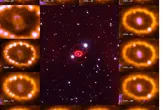
Hubble Space Telescope observations of the aftermath of a giant star explosion are offering a new glimpse into the events that follow the collapse of a massive dying star.
This well-known supernova remnant in a neighboring galaxy has been studied for more than 10 years, but the recent observations could glean new knowledge of how such stellar debris helps shape the evolution of galaxies.
The new study, led by Kevin France, a research associate at the Center for Astrophysics and Space Astronomy at the University of Colorado in Boulder, targeted the remnants of star SN1987A, which was first discovered in 1987.

Stars like this that have at least eight times the mass of our sun are considered "massive" stars, France said, and they speed toward death very quickly. Unable to support their weight any longer, these stars end their lives by collapsing in spectacular supernova explosions. [Video of SN1987A]
"These stars are so massive that they use their fuel very quickly," France told SPACE.com. "Our sun lives for billions and billions of years because it's kind of a middle-weight star."
In a supernova explosion, the material that made up the insides of the star and its surrounding atmosphere is ejected into the galaxy by a blast wave. Huge amounts of matter and energy are dispelled into what is known as the circumstellar environment.
The interaction of the stellar debris with this circumstellar environment creates a system called a supernova remnant. By studying this process and the composition of the emissions, astronomers continue to unlock clues about the evolution of galaxies.
Get the world’s most fascinating discoveries delivered straight to your inbox.
Studying the emissions
France and his colleagues used Hubble's spectroscopic observations to examine the composition of the ejected material, and to determine how quickly it is interacting with the circumstellar environment.
They detected plenty of heavy elements – ranging from oxygen to iron – that were produced in the explosion being deposited into the galaxy via the supernova's blast wave.
"We detected highly ionized nitrogen for the first time coming from the very hot gas," France said. "We also saw a lot of hydrogen emissions. Hydrogen is the most abundant element in the universe, so it's not surprising that we're seeing a lot of it."
What was surprising, however, was the fact that the hydrogen emissions were brightening over the course of about 10 years.
"This brightening is telling us that more and more emission is being produced, and it's becoming more intense," France explained. "But, what it's really doing is telling us the amount of material that is crossing into the interaction zone where the blast wave is interacting with the circumstellar material."
In the Hubble images of SN1987A, what looks like a string of pearls appears around the site of the former star. These "pearls" of circumstellar material are made up of material that was emitted before the star exploded, as it was preparing to die.
Light from the supernova itself illuminates the pearls (as seen in these images of the supernova), and as the supernova debris interacts with the circumstellar material over time, the pearls will eventually form a continuous ring around the remnant, France said.
The new study is detailed in the Sept. 3 issue of the journal Science.
Getting to know SN1987A
SN1987A is about 150,000 light-years away from Earth on the outskirts of the Tarantula Nebula in the Large Magellanic Cloud, the nearest galaxy to our own Milky Way.
The age of the original star that set off the explosion remains unclear, but is estimated to be between 5 and 10 million years.
The well-studied supernova was first discovered by an observer serendipitously.
"He went outside with a telescope and looked up at the Large Magellanic Cloud and thought he saw a new star there," France said. "Since that doesn't happen every day, they turned just about every telescope that could be turned toward it, and it turns out we actually caught one of these stars exploding, pretty much from day one. It has really allowed us an unprecedented look at a young supernova remnant."
The early detection has allowed astronomers to observe the evolution of SN1987A from year-to-year on a human timescale – a rarity in astronomy.
Expanding and rebounding
Analysis of the remnant's evolution over time showed that the shock wave from the supernova expanded into the circumstellar environment before rebounding back again.
"If you imagine the string of pearls – instead of being a clump of gas, imagine it being just a solid barrier," France said. "The material from the blast wave has gone out, run into the inside of this string, and then bounced back."
The researchers were able to determine that the ejected material in the blast wave was traveling at a blistering speed as it was dispelled outward – about 4 percent the speed of light.
"Light moves pretty quick, so seeing material move at even a few percent of the speed of light is pretty significant," France said.
Furthermore, a supernova's powerful and intense effect on its immediate environment could trigger much larger cosmic interactions, France said.
"They do produce so much energy that they tend to shape how a galaxy evolves over time," he said. "There aren't other processes in a typical galaxy that are as energetic as a supernova. If enough of these things happen, these could be the big players in determining how a galaxy evolves."

Denise Chow was the assistant managing editor at Live Science before moving to NBC News as a science reporter, where she focuses on general science and climate change. Before joining the Live Science team in 2013, she spent two years as a staff writer for Space.com, writing about rocket launches and covering NASA's final three space shuttle missions. A Canadian transplant, Denise has a bachelor's degree from the University of Toronto, and a master's degree in journalism from New York University.