LiveScience Image Gallery
Extreme Living: Scientists at the End of the Earth
-
Patrick Hovey / National Science Foundation
Research Station
An elevated dorm at NSF's Amundsen-Scott South Pole Station is shown with a new elevated station in the background. The photo was taken on Sept. 9, 2005. The Pole is currently experiencing a period known as civil twilight; the sun will not rise above the horizon until late September. Click to enlarge.

-
Patrick Hovey / National Science Foundation
Open House
Unoccupied Jamesway huts wait for the summer station population to arrive in late October. Click to enlarge.
-
Patrick Hovey / National Science Foundation
Stalled
A frozen loader waits for the return of the sun at NSF's Amundsen-Scott South Pole Station. Click to enlarge.
-
Andy Sajor / NSF
Severe Weather
A research team is shown braving the harsh conditions in the Antarctic interior on a mountaintop roughly 3,900 meters (13,000 feet) high, near the Beardmore Glacier. Click to enlarge.
-
Peter West / National Science Foundation
Beneath the Surface
Principal Investigator James Morison, of the University of Washington, takes water samples from the Arctic Ocean near the North Pole. The sampling is one of several measurements taken annually as part of the National Science Foundation's North Pole Environmental Observatory project. Click to enlarge.
-
Peter West / National Science Foundation
Heavy Machinery
A winch at the National Science Foundation's North Pole Environmental Observatory is used to retrieve a mooring that has been collecting oceanographic data from the Arctic Ocean for a year. Click to enlarge.
-
Peter West / National Science Foundation
Collecting Samples
James Osse, a University of Washington field engineer, skims ice from the surface of a hole used to retrieve a deep-sea mooring at the National Science Foundation's North Pole Environmental Observatory. Click to enlarge.
-
Peter West / National Science Foundation
Beauty of the Sun
Personnel from the University of Washington break down the mooring camp erected as part of the National Science Foundation's North Pole Environmental Observatory. Click to enlarge.
-
Peter West / National Science Foundation
March of the Penguins
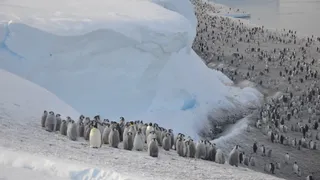
Adelie penguins are wandering on the ice of McMurdo Sound. Click to enlarge.

-
Peter West / National Science Foundation
Hi-tech
Douglas MacAyeal, a National Science Foundation-funded researcher from the University of Chicago, uploads new instructions to an automated weather station on iceberg B-15A. MacAyeal landed on the immense iceberg, perhaps for the last time, in January 2005 to service weather stations he had placed on the iceberg a year ago. Click to enlarge.
-
Peter West / National Science Foundation
Master Plan
U.S. Coast Guard pilot Sidonie Bosin sketches out a proposed route for an informal photo reconnaissance of iceberg B-15. Click to enlarge.
-
National Science Foundation
Means of Transportation
The Snow Science Traverse-Alaska Region (Snow STAR) team, their snowmobiles, and sleds. The covered sled is heated and houses the computers used in a number of tests done on the snow at each station. The SnowSTAR team left Nome, Alaska in March of 2002 to conduct a 35-day snowmobile traverse to scour the Alaskan tundra for clues to the role snow cover plays in climate change. The team analyzed the chemistry and composition of snow along the route to determine the source of the snow, and how much it has been affected by arctic haze. Click to enlarge.
-
National Science Foundation
Deep Inside
Chemical sampling of snow layers. Two classes of samples were taken along the route of the SnowSTAR traverse. Here, ultra-clean procedures are in use because these samples will be analyzed for trace elements and metals. Click to enlarge.
-
Peter West / National Science Foundation
Rough Waters
Assisted by a member of the Healy's crew, Stephane Plourde, of the Woods Hole Oceanographic Institution, fends off ice flows to retrieve the sampling net during the Western Shelf-Basin Interactions research cruise off Barrow, Alaska. Long hours and hard work are elements of any scientific research cruise. Click to enlarge.
-
Boomerang team
Balloon-based Astronomy
With Mt. Erebus, the world's southernmost active volcano, as a backdrop, the balloon that carried the BOOMERANG telescope on its 10-day trip around the Antarctic continent is inflated. The launch was preceded by two months of assembly at McMurdo Station, NSF's logistics hub in Antarctica. Click to enlarge.