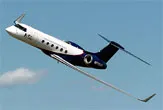
Most pilots try to avoid whirlwinds, but a team of scientists is planning to use one of the nation's newest and most advanced research aircrafts to hunt them down.
The modified Gulfstream V jet, called HIAPER, will study turbulent airstreams and whirlwinds known as "rotors" that form along California’s Sierra Nevada Mountain range.
HIAPER was expected to fly its first mission today.
Latest Videos From
Mountain storms
Researchers aboard the aircraft will study the rotors from above and drop temperature- and wind-sensitive devices, called dropsondes, into the storms' most turbulent areas. They will also explore the way turbulent airstreams, called mountain waves or "lee waves," effect atmospheric regions as high as the stratosphere, which is about 10 to 30 miles above the Earth’s surface.
"This will be a fantastic part of the atmosphere to be flying around in because of the mountain waves, the turbulence, and the movement of the air masses," said Jorgen Jensen, a scientist from the National Center for Atmospheric Research (NCAR).
"The amount of data we will collect will be absolutely unprecedented for describing air flow over mountains," Jensen said.
HIAPER, which stands for High-performance Instrument Airborne Platform for Environmental Research, will be one of three aircrafts taking part in the Terrain-Induced Rotor Experiment, or T-REX. Unlike HIAPER, the other two aircrafts, King Air and BAE146, will actually fly into the storms.
Airplane hazards
Rotors form on the sides of steep mountains that are sheltered from the wind (the lee side) and have been known to contribute to a number of aircraft accidents. They are common in the Sierras because the region has the steepest topography in the continental United States.
Results from the T-REX project are expected to help scientists better understand mountain waves and rotor evolution and also help forecasters predict when and where storms are most likely to form.
In addition to HIAPER’s measurements, researchers will also probe the mountain waves and rotors from the ground using various techniques, including radar, automated weather stations and balloons.
The $81.5 million dollar HIAPER aircraft is owned by the National Science Foundation and operated by the NCAR. It can soar to an altitude of 51,000 feet and cruise for 7,000 miles; it will fly from its base in Jefferson County Airport in Colorado to Owens Valley in California’s Sierra Nevada.

 Live Science Plus