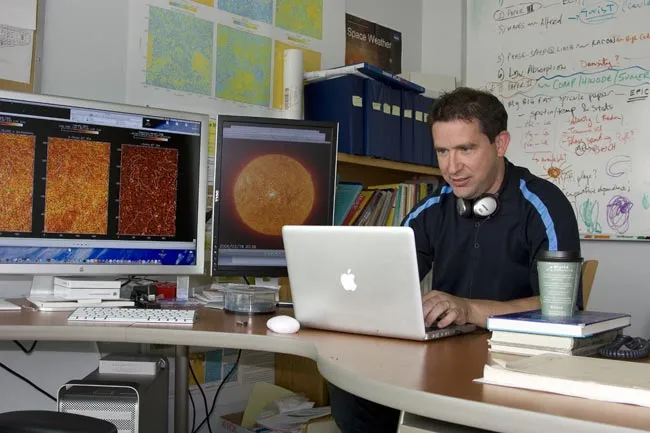
Solar physicist Scott McIntosh studies the inner — and outer — workings of the sun, including oscillations in the Sun's corona known as Alfvén waves. Such waves transport energy outward from the surface of the sun, and by studying them, McIntosh and others are gaining more insight into the fundamental behavior of solar magnetic fields. The knowledge is helping scientists achieve a fuller understanding of how the Sun affects the Earth and the solar system. His work made headlines in 2007 and continues to break new ground with new findings. Below, McIntosh answers the ScienceLives 10 Questions. Name: Scott McIntosh Age: 35 Institution: NSF's National Center for Atmospheric Research (NCAR), High Altitude Observatory (HAO) Field of Study: Solar Physics
What inspired you to choose this field of study? I got into it by accident. I planned to get a Ph.D. in medical imaging, studying pre-stroke conditions. Knowing that I specialized in medical imaging techniques, a solar physics professor asked me to use those skills to help interpret ultraviolet (UV) light from the solar atmosphere. Deciphering this UV light provides information that’s useful for understanding the solar plasma — its temperature, density, and chemical makeup, among other characteristics, which in turn tells a lot about the sun as a system. I fell in love with the challenge of putting disparate pieces of information together to understand how the sun behaves. Due to its close connection to conditions on Earth, a solid understanding of the complex solar atmosphere and its output is critical.
What is the best piece of advice you ever received? My ruling mantra is to treat people as I would like to be treated myself — and that includes everyone from the janitorial staff to NCAR’s director, although another important core directive is something my mother imparted: "Keep your mouth shut and let people think you're an idiot rather than open it and prove it." When Tom Bogdan (currently Director of NOAA’s Space Weather Prediction Center) worked at NCAR, he often told me to "Keep on keeping on!" I always try to keep pushing forward.
Latest Videos From
What was your first scientific experiment as a child? I grew up a "skiddler" — that's Scottish slang for someone who always plays with water. The house I grew up in had a fireplace with a small cabinet in it, making the fireplace an ideal laboratory. I experimented with all kinds of liquids, mixing them together or fermenting them just to see what happened — I ruined at least five coffee tables in my pursuit of my scientific curiosity. Genetics must be at play, because my two oldest kids are also skiddlers — it's too early to know about the youngest one, she's only a year old, but she sure does love the cat's water bowl and the bath.
What is your favorite thing about being a scientist or researcher? As a scientist I get to play with cool toys and the latest technology — for me, this includes spacecraft and computers. I get to work on the bleeding edge of research, which is always fun, and I am working on a variety of projects, so I’m always doing something interesting.
What is the most important characteristic a scientist must demonstrate in order to be an effective scientist? Scientists need to communicate well — both verbally and in writing.
What are the societal benefits of your research? The Sun is something most people take for granted, but it has a huge impact on human life. As just one example, ultraviolet output from the Sun’s chromosphere — the layer of atmosphere just above the Sun’s surface seen as a red jagged ring during solar eclipses — affects the Earth's atmospheric chemistry and may have some small impact on climate change.
Who has had the most influence on your thinking as a researcher? I feel lucky to have had several strong mentor/manager relationships during my career so far; each has influenced me a great deal. Tom Bogdan, who was a senior scientist when I first started at NCAR, is one. His ideas, energy, enthusiasm, and sense of humor always spurred me on to look at the "big picture." Phil Judge, an NCAR senior scientist, had massive influence on me even before I began working with him here. Without his collaboration as a graduate student in Scotland, I would probably not be where I am today. His frank pursuit of complex problems is a basis for my own style of research. Joe Gurman at NASA's Goddard Space Flight Center was a great facilitator for me, as well as to a host of other young scientists. He supported me and many others under his direction to explore the scientific questions that most interested us while we worked for NASA's Solar and Heliospheric Observatory (SOHO) Mission.
What about your field or being a scientist do you think would surprise people the most? We're not all eggheads. We have normal lives. For instance, I still love to play soccer and golf, although not as competitively as I did when I was younger. I play soccer with a team of people who would have never guessed I was a scientist. Once they found out, 18 months after meeting me when someone spotted my ID, they were surprised because I didn’t exactly fit their scientist stereotype.
If you could only rescue one thing from your burning office or lab, what would it be? My headphones. I use them when I'm coding, when I’m writing, when I'm thinking. My coffee cup is another critical tool that I'd also try to grab.
What music do you play most often in your lab or car? I listen to everything from Led Zeppelin to classical guitar performed by Segovia, to U2 and Alanis Morissette. It depends on what I'm doing. When writing code, I’ll play Led Zeppelin. When writing papers, I like something softer, like U2 or REM. I like listening to talk radio when I need help focusing on a question as the stimulus helps me concentrate. When doing homework as a kid, I'd have the television on, and listen to music on the radio. I'd watch, listen, and do my homework, all at the same time — the more stimulation, the more I zoned in.

 Live Science Plus