This ScienceLives article was provided to LiveScience in partnership with the National Science Foundation.
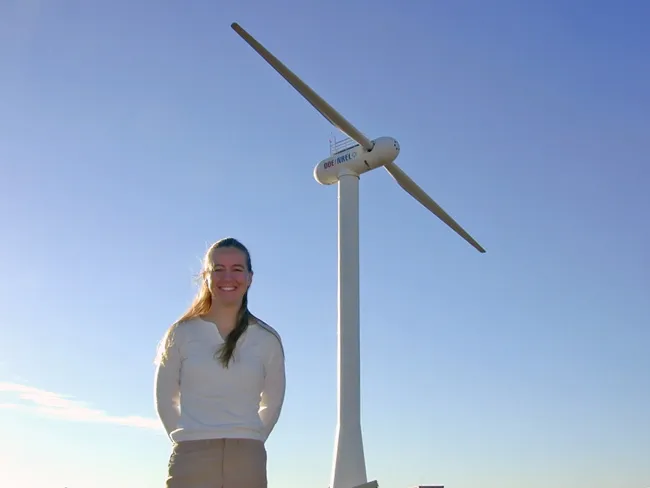
Exploring ways to improve and maximize energy resources is essential in our world today. Kathryn Johnson is the Clare Boothe Luce Assistant Professor at the Colorado School of Mines in Golden, Colorado where she studies how to make wind turbines and wind farms more energy efficient, reliable and cost-effective. While Johnson’s degree background is in electrical engineering, her research is in control systems, and for the past nine years she has studied control of wind turbines and wind farms. Her work is rewarding both because wind energy has the potential to benefit society and because being a researcher means always learning new things about the world and getting paid for it.
Name: Kathryn Johnson Age: 32 Institution: Colorado School of Mines Field of Study: Electrical Engineering – Control Systems – Wind Energy
Latest Videos From
What inspired you to choose this field of study? I have always enjoyed solving problems using math and science, so engineering is a great choice for my skills and interests. My father is a mechanical engineer and a great role model to show what engineering is really like. I also want to contribute to a greener energy future and I enjoyed an amazing opportunity to do my doctoral and postdoctoral research at the National Renewable Energy Laboratory’s National Wind Technology Center, which inspired me to choose wind energy as an application for my research.
What is the best piece of advice you ever received? I think the best advice is to live the life I want to live, and not try to satisfy the expectations of others. A big part of that is doing what I enjoy both within and outside of my career.
What was your first scientific experiment as a child? I don’t remember my first experiment because my dad had me doing them at such a young age. I do remember him giving me math and science problems to work out instead of telling me bedtime stories. I also remember a bad experience in grade school where I did a Science Fair experiment on how different concentrations of salt affected the freezing temperature of water. The reason this one stood out is that one of the judges gave me a really bad score and told me that a child of my age couldn’t possibly understand my experiment. He said that my parents must have just done the experiment for me. I was really upset at the time, but the experience actually helped me to understand that not everybody was going to be supportive, and that I needed to learn to trust myself.
What is your favorite thing about being a researcher? I love having the opportunity to work on projects that are interesting to me and to direct my own research. I also love working around people who have similar and different interests because I can learn so much from my colleagues. There are so many opportunities at a university—they’re incredible places for people who never get tired of learning.
What is the most important characteristic a researcher must demonstrate in order to be an effective researcher? You have to be persistent and to believe in yourself and your abilities. There are lots of times in research when you feel like you’re stuck up against a brick wall, just not making progress no matter what you try. Usually, it just takes more time and effort to solve the problem and move forward. Sometimes, you never do find the way forward for that particular problem, or you find out that you don’t have the resources to solve it. You have to be OK with that, and understand that just because you get stuck sometimes doesn’t mean you’re not a good researcher.
What are the societal benefits of your research? My work is focused on ways to decrease the cost of wind energy, making it more competitive with conventional electricity-generation sources. Society can benefit from less-polluting, locally “grown” energy.
Who has had the most influence on your thinking as a researcher? My dad, who modeled what it was like to be an engineering professor when I was young and got me interested in math and science at an early age.
What about your field or being a researcher do you think would surprise people the most? Most people don’t even know that there is an engineering research area called “control systems,” but it’s a neat area because there are control systems in most technologies we use. Sometimes people confuse the field with programming instructions into computers, but it’s really not about programming. Think about your car’s cruise control feature. You pick a speed that you want to go, and then the car takes over and gives the engine the right amount of gas to go that speed. The internal workings of how to determine what amount of gas the car needs is one example of a control system we use in our everyday lives. Control systems are also in our ovens, our cell phones, the tools and instruments a surgeon uses and tons of other places.
If you could only rescue one thing from your burning office or lab, what would it be? Assuming I’m safe, definitely my laptop.
What music do you play most often in your lab or car? I listen to all sorts of music from classic to today’s popular music. In the car, I enjoy NPR, especially Science Friday.
Editor's Note: This research was supported by the National Science Foundation (NSF), the federal agency charged with funding basic research and education across all fields of science and engineering. Any opinions, findings, and conclusions or recommendations expressed in this material are those of the author and do not necessarily reflect the views of the National Science Foundation. See the ScienceLives archive.
Websites:
pp.28-31 of http://issuu.com/minespr/docs/2010resarchsngls
http://magazine.mines.edu/2008/Winter/Departments/new_frontiers.html
http://inside.mines.edu/~kjohnson/sampleprojects.html
http://crew.colorado.edu/
Green Revolution Video (Wind): http://www.nsf.gov/news/special_reports/greenrevolution/

 Live Science Plus