
 Live Science Plus


Antarctica's 'Doomsday Glacier' is fighting an invisible battle against the inner Earth, new study finds
Underground heat is cooking the Thwaites Glacier from below, and could push it closer to collapse.

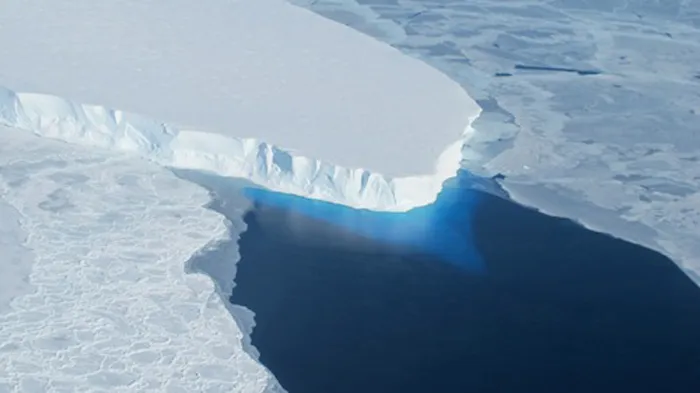
West Antarctica is one of the fastest-warming regions on Earth. For evidence, you need look no further than Thwaites Glacier — also known as the "Doomsday Glacier."
Since the 1980s, Thwaites has lost an estimated 595 billion tons (540 billion metric tons) of ice, single-handedly contributing 4% to the annual global sea-level rise during that time, Live Science previously reported. The glacier's rate of ice loss has accelerated substantially in the past three decades, partially due to hidden rivers of comparatively warm seawater slicing across the glacier's underbelly, as well as unmitigated climate change warming the air and the ocean.
Now, new research suggests that the warming ocean and atmosphere aren't the only factors pushing Thwaites to the brink; the heat of the Earth itself may also be giving West Antarctica's glaciers a disproportionately nasty kick.
In a study published Aug. 18 in the journal Communications Earth & Environment, researchers analyzed geomagnetic field data from West Antarctica to create new maps of geothermal heat flow in the region — essentially, maps showing how much heat from Earth's interior is rising up to warm the South Pole.
The researchers found that the crust beneath West Antarctica is considerably thinner than in East Antarctica — roughly 10 to 15 miles (17 to 25 kilometers) thick in the West compared with about 25 miles (40 km) thick in the East — exposing Thwaites Glacier to considerably more geothermal heat than glaciers on the other side of the continent.
"Our measurements show that where the Earth's crust is only 17 to 25 kilometers thick, geothermal heat flow of up to 150 milliwatts per square meter can occur beneath Thwaites Glacier," lead study author Ricarda Dziadek, a geophysicist at the Alfred Wegener Institute (AWI), Helmholtz Centre for Polar and Marine Research in Germany, said in a statement.
Because West Antarctica sits in an oceanic trench, the crust beneath the seabed is much thinner than the crust below East Antarctica. Scientists have long suspected that this comparatively thin crust must be absorbing more heat from the planet's upper mantle (which experiences average temperatures of 392 degrees Fahrenheit, or 200 degrees Celsius), impacting the formation and evolution of glaciers there over millions of years.
Get the world’s most fascinating discoveries delivered straight to your inbox.
In the new study, the researchers quantified that difference in heat flow for the first time. Using a variety of magnetic field datasets, the team calculated the distance between the crust and the mantle at various spots throughout Antarctica, as well as the relative heat flow in those areas.
It's hard to tell exactly how warm the glacier is where the ice meets the seabed, as different types of rock conduct heat differently — however, the researchers said, it's clear that this extra supply of heat in the West can only mean bad news for Thwaites.
"Large amounts of geothermal heat can, for example, lead to the bottom of the glacier bed no longer freezing completely or to a constant film of water forming on its surface," study co-author Karsten Gohl, also a geologist at AWI, said in the statement. Either of these conditions could cause the glacier's ice to slide more easily over the ground, causing the glacier's ice loss to "accelerate considerably," Gohl added.
RELATED CONTENT
A scenario like that could put the Doomsday Glacier's name to the test; if Thwaites Glacier were to entirely collapse into the ocean, global sea levels would rise by about 25 inches (65 centimeters), devastating coastline communities around the world, Live Science previously reported. What's more, without the glacier plugging the edge of the West Antarctic Ice Sheet like a cork in a bottle of wine, ice loss could accelerate dramatically in the entire region, leading to unprecedented levels of sea level rise.
Researchers will soon have a chance to further hone their measurements of the heat flow below Antarctica. A major international research project is currently underway at the South Pole, including missions to drill ice cores that stretch down to the bed of Thwaites Glacier. Heat flow measurements from these core samples could give scientists a better idea of how much time is left on the Doomsday Glacier's ticking clock.
Originally published on Live Science.

Brandon is the space / physics editor at Live Science. With more than 20 years of editorial experience, his writing has appeared in The Washington Post, Reader's Digest, CBS.com, the Richard Dawkins Foundation website and other outlets. He holds a bachelor's degree in creative writing from the University of Arizona, with minors in journalism and media arts. His interests include black holes, asteroids and comets, and the search for extraterrestrial life.